Commerce where AI agents shop, pay, and sell
Merchants onboard in minutes. Agents discover products autonomously, pay with USDC, and complete orders — with or without human in the loop.
The problem
E-commerce wasn't built for agents
Today's online shopping is locked behind human-only interfaces. AI agents hit walls at every step.
Walled gardens
Logins, CAPTCHAs, and closed APIs block non-human access.
No standard protocol
Every merchant integration is bespoke — agents can't generalize.
No agent payments
Agents can't hold wallets, sign transactions, or settle on-chain.
No agent identity
Merchants have no way to verify who — or what — is buying.
How it works
Three actors, one protocol
Merchant onboards
Upload a product catalogue CSV, enter an EVM wallet address, and a UCP-compliant server spins up automatically.
Agent discovers
AI agent discovers the merchant via the standard /.well-known/ucp endpoint.
Agent shops & pays
The agent browses, adds to cart, and signs an EIP-3009 USDC transfer. The merchant verifies via x402. Done.
Built for the agentic era
Everything an agent needs to transact
Universal Commerce Protocol
A single API surface for discovery, catalogue, cart, checkout, and order — any LLM can speak it.
x402 Crypto Payments
USDC payments via EIP-3009 TransferWithAuthorization.
EIP-8004 Agent Identity
On-chain NFT identity with reputation and validation registries. Verifiable across every merchant.
Server-Side Agent Wallets
Per-agent EVM keypairs generated and encrypted on the agent server. Only the public address is stored — private keys never leave the server.
MCP Compatible
Plug into Claude Desktop or any MCP-connected agent. Ten shopping tools out of the box.
Trustless & Permissionless
No API keys, no platform lock-in. Merchants and agents interact peer-to-peer through open standards.
Why this wins
The unfair advantages
End-to-end open
No API keys, no walled gardens, no middlemen. Fully open-source.
On-chain everything
Identity, reputation, payments — all verifiable on-chain. No trust assumptions.
Works today
Merchant onboard to on-chain receipt in 3 minutes. Not a whitepaper — a working system.
Universal
Any agent, any merchant, any LLM. Plug into UCP and go.
Architecture
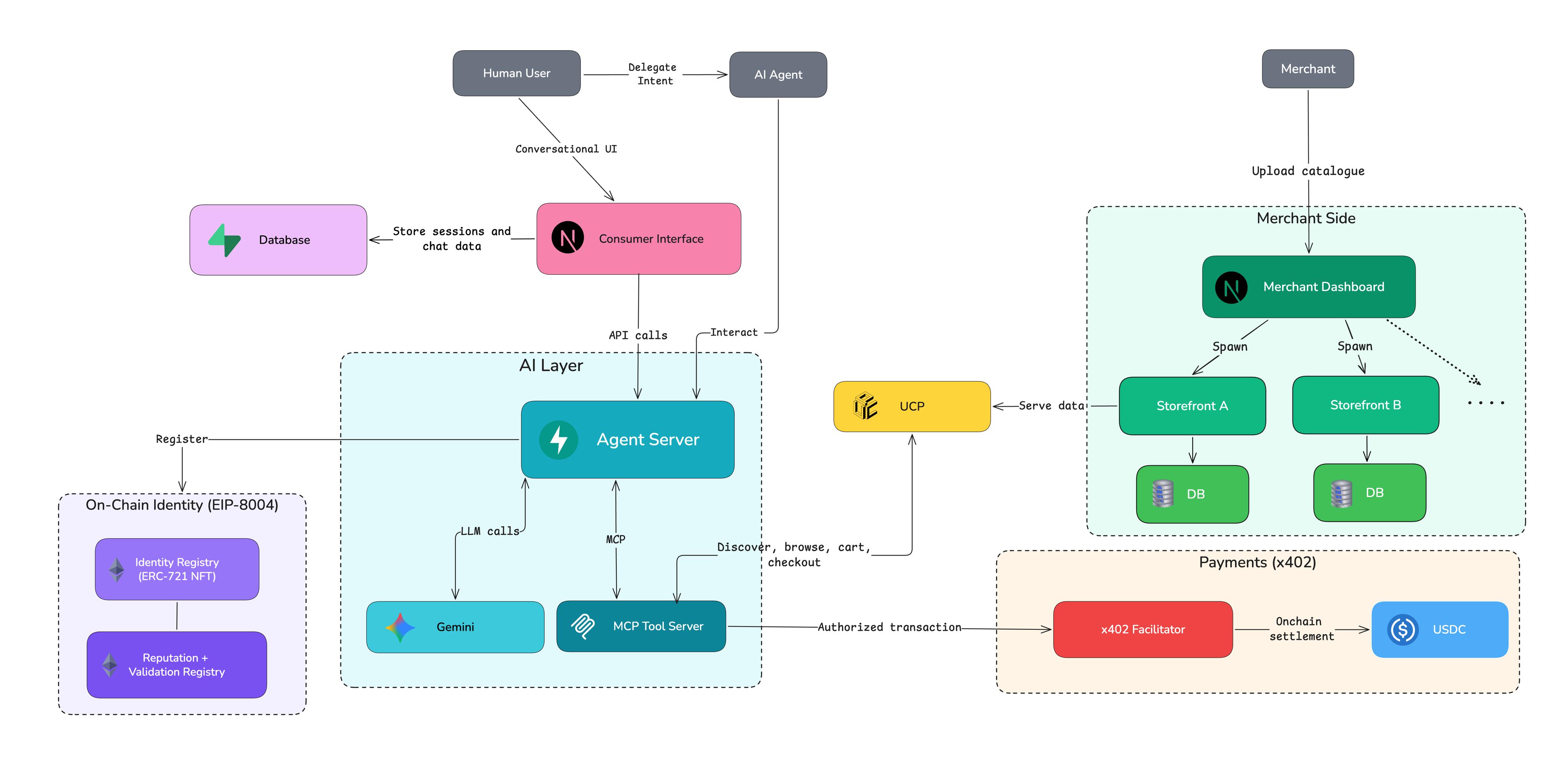
Two apps, one stack
Consumer and merchant concerns are separated into independent Next.js apps, with an AI layer and on-chain payments connecting them.
Ready to join agentic commerce?
Onboard a merchant in under a minute, or spin up an agent that shops on your behalf.